Project Dynamics
addtimes:2026-08-28 click:235 author:Gimsun
How do you make your store "jump out" from a sea of brands? Building a story-rich, instantly recognizable DP spot is fast becoming the key to winning natural foot traffic. And inflatable display props, with their intense visual punch and flexible scene adaptability, are turning into the go-to way for brands to get noticed.
Customers walking through a mall corridor tend to behave in three predictable ways:
Visual inertia. Their eyes stay level, straight ahead, rarely drifting sideways toward a store. Without a strong visual jolt, they simply walk past at a steady pace.
A vanishingly short pause threshold. Miss their eyes in the golden 3 seconds, and the customer is gone.
Path-first instinct. Most people move in a straight line along the main walkway and won't willingly wander off course to "explore" a store.
The inflatable props that have gained popularity in recent years offer a whole new way to break that pattern. They're one of the most representative display tools around.
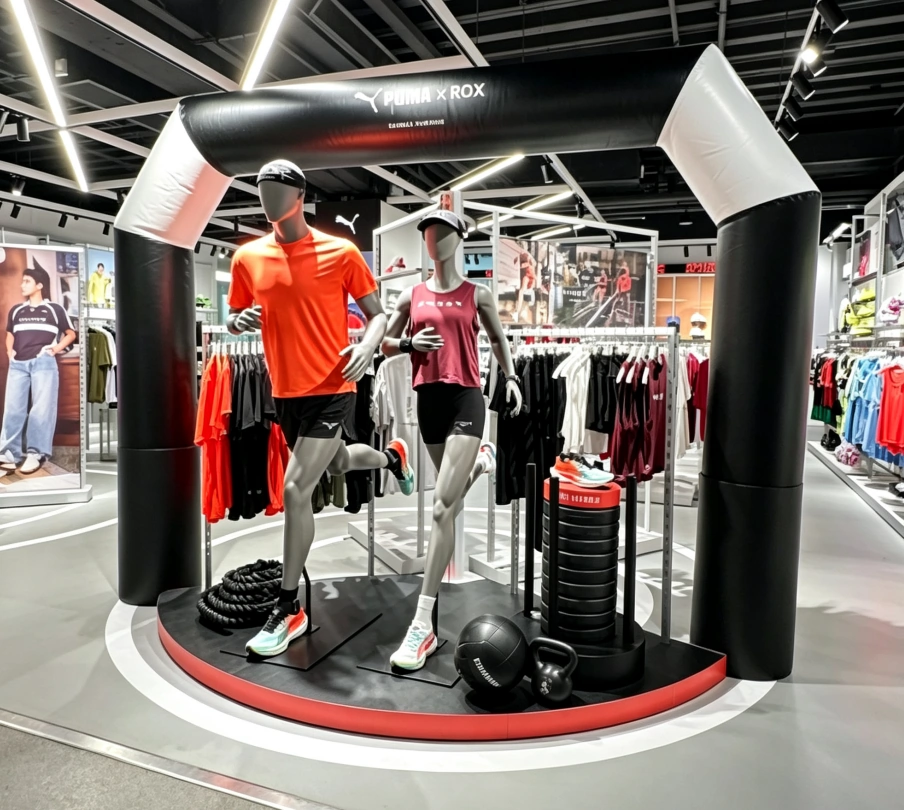
Take the PUMA × HYROX in-store themed booth we recently delivered. A large 3D inflatable arch sits at the visual core of the scene, turning what was once a flat mannequin display into an immersive race-day experience. It does more than "decorate" — it's an invisible traffic magnet. It sparks curiosity from ten meters away, pulling customers off their path and toward the store, and it turns "walking by" into "walking in."
This logic echoes what Pine and Gilmore argued in The Experience Economy: "Goods are tangible, services are intangible, and experiences are memorable." A narrative DP stages a themed scene, turning the atrium and the window into a miniature theater. Customers get drawn into the story, stop on their own, and reach for their cameras. Shopping stops being a simple act of buying and becomes an immersive experience you can feel and take part in — and foot traffic and conversion follow naturally.
In this visual merchandising scheme, inflatable display props are the physical carrier of the narrative scene. They decide the emotional trigger a customer feels at first glance. The overall composition of the store display, meanwhile, decides whether they'll linger. Only when the two work together do you truly hit that goal: grab attention in 3 seconds, draw customers from 10 meters away.
Material Comparison Table
| Material | Visual impact | Setup difficulty | Cost | Reuse/storage | Mall approval |
|---|---|---|---|---|---|
| Inflatable air mold | Strong (can reach huge sizes) | Single-person inflation | Low (no mold fee) | Deflate and fold, easy to store and ship | No open flame or nails, smooth |
| Ironwork | Medium | Requires welding and assembly | High | Bulky | Requires open-flame approval |
| Wood | Medium | Requires carpentry | Medium | Hard to store | Depends on workmanship |
| Fiberglass | Strong | Requires molds and hoisting | Very high | Bulky | Hoisting needs safety review |
| Acrylic | Weak (mostly flat/small) | Requires custom fabrication | Medium | Fragile | Average |
For large storefront installations, the market offers ironwork, wood, acrylic, fiberglass, and more. But for temporary DPs, pop-up stores, and themed co-branded scenes, we've weighed the options and recommend the inflatable air mold. Here's why:
The giant 3D arch forms a natural visual barrier. Its black-and-white color-blocked silhouette frames a standalone display space, faithfully recreating the "start arch" of a HYROX fitness race. Compared with a flimsy flat poster, it fuses mannequins, sports equipment, and apparel into a single whole. From across the mall, it communicates the race theme instantly and locks the customer's gaze. That sheer visual grab is the strongest edge inflatable display props have over traditional materials.
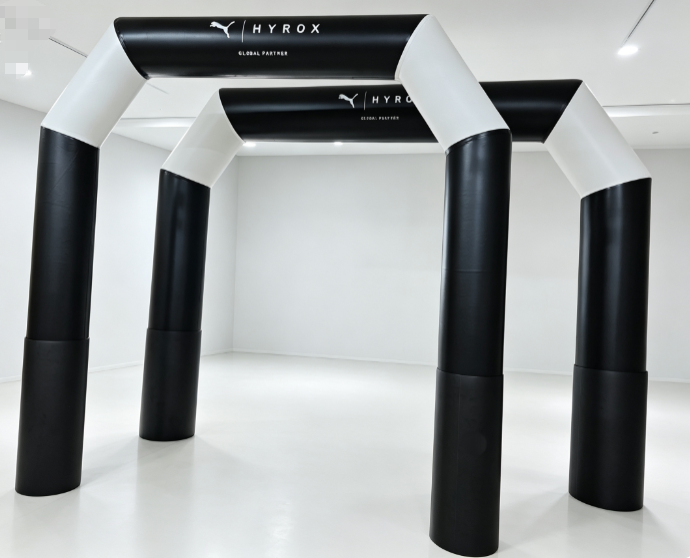
This is the core physical advantage of the inflatable air mold. After production, we run a second round of testing on the mold, so you know the finished piece arriving on site is trouble-free. Unlike rigid fixtures that need welding, assembly, and a fixed frame, the inflatable only needs power on site. It inflates in moments, and one person can handle the whole setup.
Takedown is just as simple. Deflate, fold, and pack — the volume collapses instantly, slashing warehousing and long-haul shipping costs. For on-site stability, we designed a PVC pipe backing with matching (black) printed graphics. It's affordable and keeps the arch standing firm. For brands with tight schedules and frequent changeovers, the ease of use of store display props decides execution speed — and inflatables are the clear winner.
Inflatable props use large curved surfaces and support virtually any 3D shape, paired with high-definition digital printing. Brand logos, co-branded marks, and campaign slogans all come through complete and crisp, matching each brand's unique display needs.
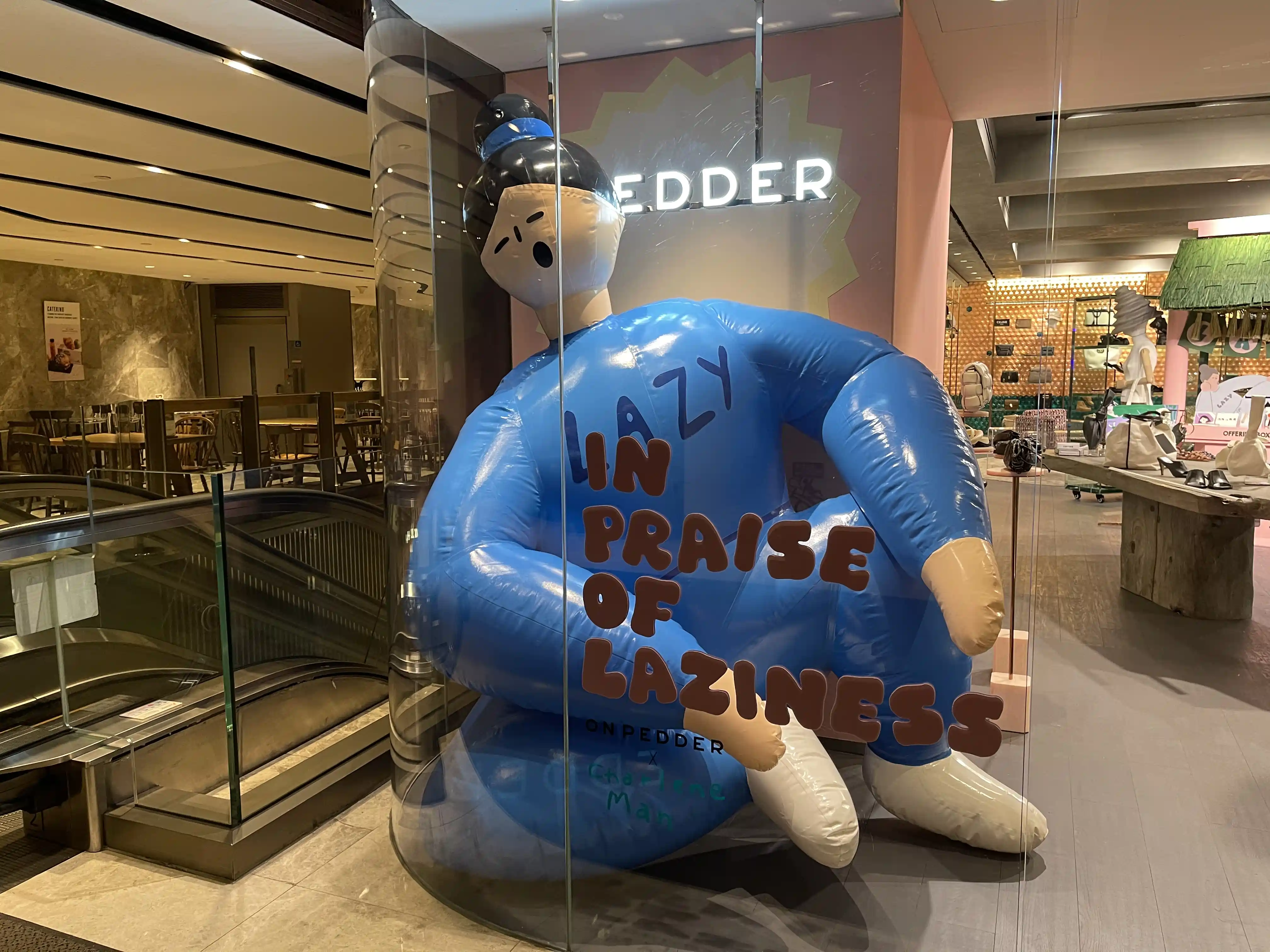
For temporary mall DPs, limited-time co-branded exhibitions, and sports-themed pop-ups, inflatable props are the absolute first choice. No open flame, no nails, no damage to floors or walls. The approval process is remarkably smooth, fitting mall requirements for short-term displays perfectly.
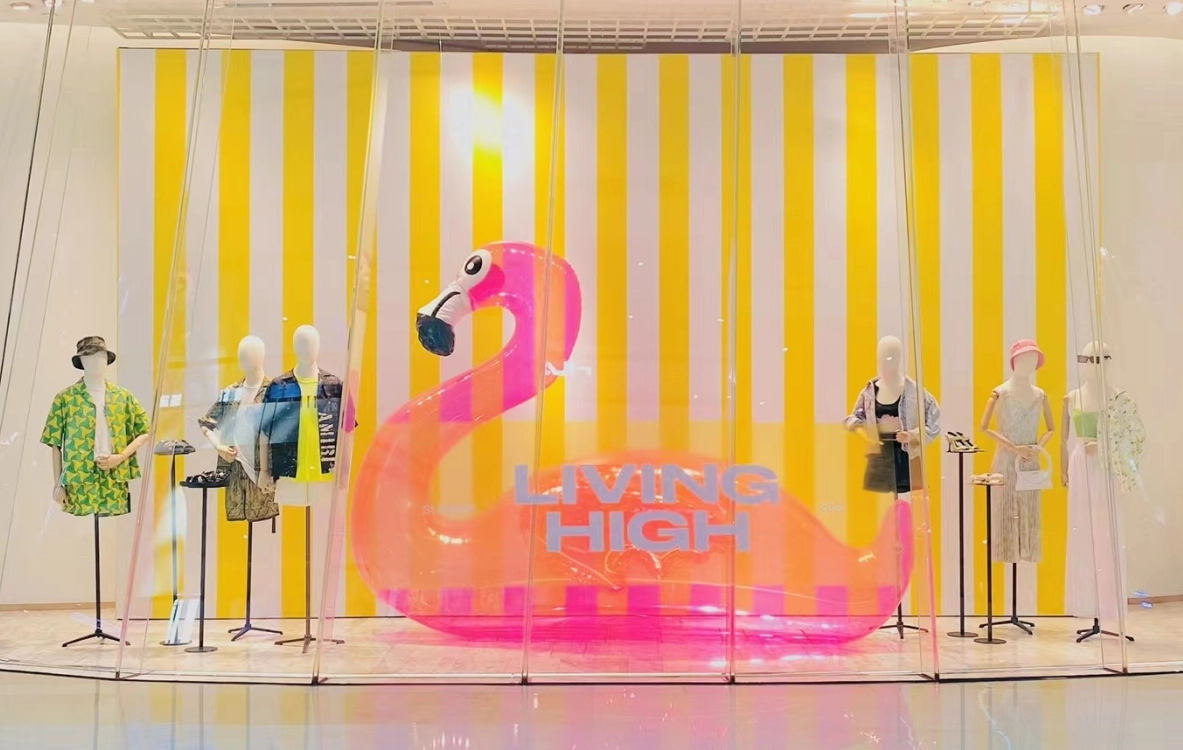
Inflatables aren't just for sports brands. Retail launches, seasonal celebrations, outdoor pop-ups, brand roadshows, and large mall events can all reuse them. Color, size, and shape adjust on demand, adapting to any brand tone or campaign theme.
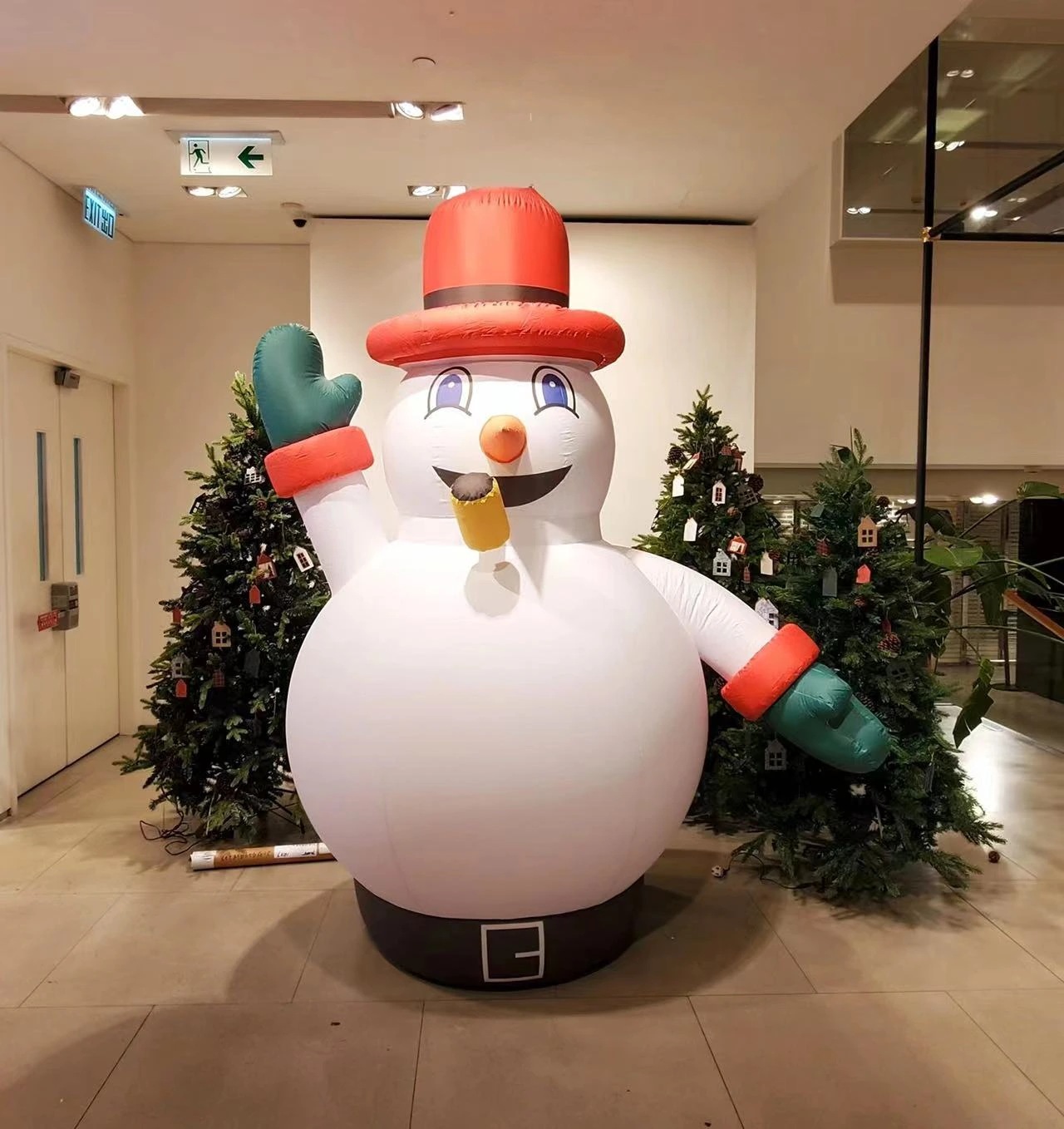
Next to metal, wood, fiberglass, and 3D-printed rigid materials, inflatable props are far more cost-competitive at the same display size. For "one-off" scenes like short-term DPs, pop-up stores, and co-branded campaigns, you skip the expensive mold costs while getting results far beyond flat printed materials. Lighter materials also mean lower storage and shipping fees, letting brands hit large-volume, high-impact display goals at a lower cost.
What this case shows is clear: the value of inflatable display props isn't "decoration." It's building immersive narrative scenes at low cost and capturing customer attention with precision. In an era of tightened budgets, this isn't just an upgrade of props — it's a proven, cost-effective offline traffic strategy.